
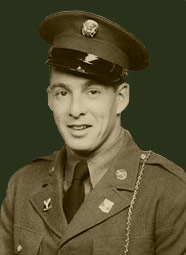
Jerry McGlone was drafted in February of May of 1941, went through basic training and was discharged in November 1941 as a buck sergeant.
He and
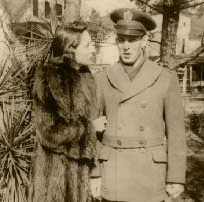
his wife were engaged on December 31, 1941 and married March 2, 1942. this
was sooner than they had planned, but Jerry was recalled to the Army and reported
on March 7, 1942. He went to Officer Candidate School and graduated as a 1st
Lieutenant in June 1942.
He was posted to a training battalion at Camp Roberts California. A training
battalion is where the Army sent men who had flunked basic training. Among
the men he commanded at Camp Roberts were a dozen Navaho, only one of which
spoke any English. He also had several Cajuns who spoke Creole - a combination
of French and English. They had to paint footprints on the parade ground to
teach these men how to march. Sometime that Fall, Jerry volunteered for the
Airborne. He preferred the idea of jumping out of airplanes while being shot
at to staying with the training battalion. When he reported to Fort Bragg
North Carolina he was disappointed to learn he would not be jumping, but would
be riding in something called a glider.
Jerry served in the 101 Airborne Division, 907 Glider Field Artillery Battalion.
By the time of the Normandy invasion he was a Captain and commander of Battery
B, consisting of 6 105mm howitzers and support troops. On June 6, 1944 the
907th landed at Normandy as part of the sea borne invasion force because there
were no gliders for them. July 14 they returned to England.
On September 17,1944 the 907th started for Holland as part of operation Market-Garden,
but fog over the English Channel caused most of the glider force, including
Jerry, to turn back to England. Four gliders were ditched in the North Sea
and the Army tried to charge Jerry for them. Bad weather delayed the returned
gliders and men until
September
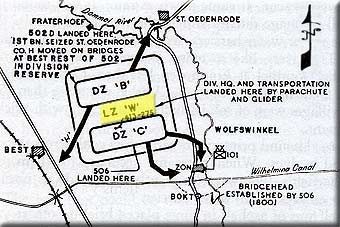
23rd. Jerry landed at landing zone W. (left)
1341 men arrived safely on the landing zone: 554 of whom belonged to the
1st Battalion of the 327th and 159 to the 81st Airborne Antiaircraft Battalion.
The rest were artillerymen: 337 from the 321st Glider Field Artillery, 190
from the 377th Parachute Field Artillery,
24 from the 907th Glider Field Artillery and the remaining 77 from Division
Artillery Headquarters.
An idea of the way this flight was cut to pieces by the fog can be gained
from the equipment figures. Of the 160 jeeps that left England only 79 safely
reached the LZ. Of the 68 guns only 40 came in. The 321st lost 3, and the
377th lost 1.Hardest hit was the flight of the 907th. All the planes towing
its twelve 105 mm howitzers turned back. (text
in italics from Rendevous with Destiny page 313)
The 907th was assigned to support the 501 Parachute Infantry Regiment who
were to capture bridges near Veghel. This is where Battery B fought until
relieved by the English. The 907th moved north with the rest of the 101 to
"the Island" and stayed in Holland until November 30, when they
were sent to Mourmelon near Paris.
On December 18 the 907th drove to Bastogne. Jerry's battery went into place
in a triangular depression bordered by two ridges and a raised roadbed near
the site of the memorial. Because of the location Battery B did not receive
any counter-battery fire through out the siege. After Bastogne, the 907th
fought in the Ardennes and then the south of Germany and Austria. Jerry and
Battery B were in Weissbach near Munich on V-E Day.
More information about the 907th is to be found in a book called Kilogram
(the 907th code name) written by Bob Minick, the nephew of a soldier from
Battery A who died during the war. (Above
text by James McGlone)
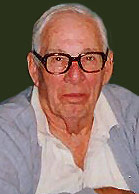
Jerry McGlone
†
August
31, 2005
(James McGlone, son of Jerry)
INDEX
